A 10W COB and Some Stray Thoughts
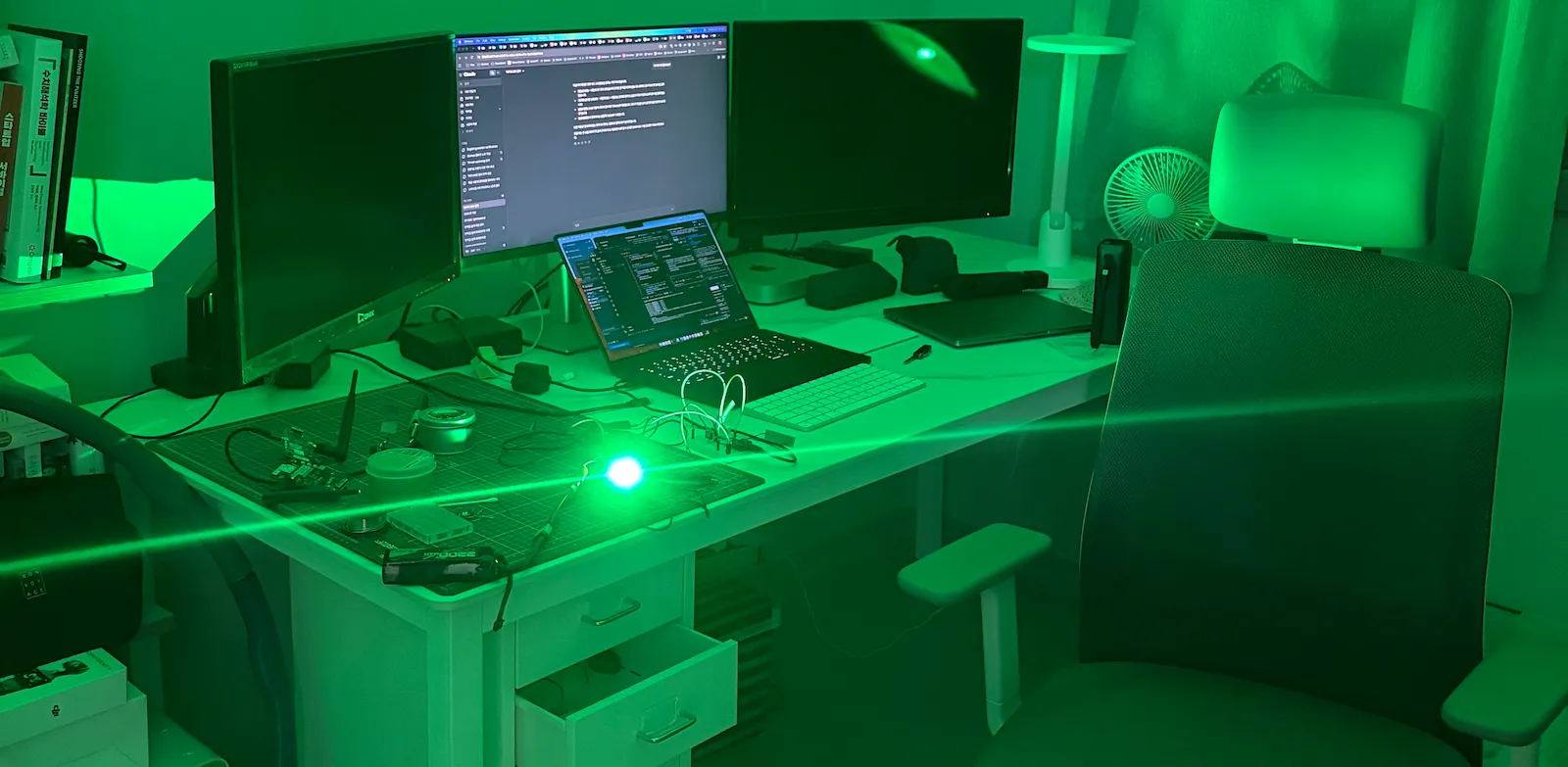
Not long ago I built a small circuit out of spare parts. It’s a 10W LED you can see from a kilometer away, powered by the kind of 3S LiPo battery used in drones and controlled by an ESP32. The circuit was simple, so I just went ahead and built it.
The parts:
-
3S LiPo 11.1V
-
10W green COB LED
- heatsink
-
3.3Ω 5W cement
-
IRLZ44N
-
10kΩ
-
XIAO ESP32S3
I’ve written up the circuit in the repo below.
https://github.com/hjunhuh/10w-cob-test
The same circuit logic can be used to make an igniter. Here’s the recipe.
Prepare 40-gauge nichrome wire and a long wire to connect it, then mix the ingredients below.
- Nitrocellulose lacquer
- HP-38 powder or smokeless powder
- Fe₂O₃
- KClO₄
Put the nitrocellulose lacquer in a small cup as the base, add smokeless powder until the mixture turns thick, then add a very small amount of aluminum powder, followed by small amounts of Fe₂O₃ and KClO₄, in that order.
Dip the nichrome tip in the mixture and let it dry (two coats).
Then attach the long wire where the LED used to be, and you’re done… or you would be. The problem is that HP-38 isn’t sold in Korea, so I have to use a different recipe.
The simplest version is to attach nichrome wire to a match and light that, but it misfires often and is very vulnerable to humidity. Ideally you’d use a smokeless powder like HP-38, but that’s not an option in Korea: under the country’s firearms and explosives law, you can’t get smokeless powder without a license. Laws like this are part of why Korea is as safe as it is. The catch is that for anyone who makes things and experiments, they can only ever be inefficient. It’s always a shame.
Thoughts
My personal dream is to create a sandbox zone with no regulation at all. It would cover chemistry (guns, explosives, everything that’s currently impossible in Korea), mechanical engineering (missiles, bombs, and so on), life sciences (animal testing and everything else), computing (no regulations, as long as nothing gets out), and nuclear (probably impossible). All of it would be allowed in a zone that sits outside Korea’s legal system, where you’re exempt from liability for pretty much anything short of actual crime.
Compared with China, Japan, and the US, Korea’s competitiveness will keep declining. “Made in China” has gained real prestige, and the quality of its top companies has risen dramatically. Korea can’t keep up with those details. China’s cheap yet high-quality manufacturing and its end-to-end supply chains are beyond what Korean capital can match. The same goes for Japan’s level of basic science and research. America’s overwhelming capital and pioneering spirit can’t be reproduced in Korea. On the other hand, Korea has already caught up with Europe in brands, industrial capability, manufacturing technology, cosmetics, and so on, and these are fields with plenty of room to grow.
In the end, Korea’s competitiveness has to come from the flexibility born of institutional freedom, freedom of expression, and a spirit of resisting authority, which China doesn’t have; from semiconductors and industrial competitiveness, which Japan doesn’t have; and from the other fields the US has no need to own (it can just buy them). Korea has to throw its full weight behind these. Then it has to pick a few fields and concentrate on them. That’s how Korea survives.
Since the 1970s, progress in the physical world has stalled. Capital flowed into computers, software, and the internet, and progress happened only there. In the real world we live in, the awe people once felt watching the Hindenburg airship is long gone. We no longer dream of flying cars, and we’ve grown far too used to the institutions and systems we call reality.
Take the igniter formula I mentioned earlier: every LLM refuses to give it. Frontier models like Claude, GPT, and Gemini come with safety policies, so they won’t give you an actual formula. You have to study and work it out yourself. And even if you use an uncensored LLM, it’s less reliable than the frontier models.
What if the bottleneck on technological progress isn’t energy or infrastructure at all, but the institutions people create?
Translated by Claude Opus 5.5