Conditions of a Nation
Translated by GPT
I recently wrote a post on LinkedIn.
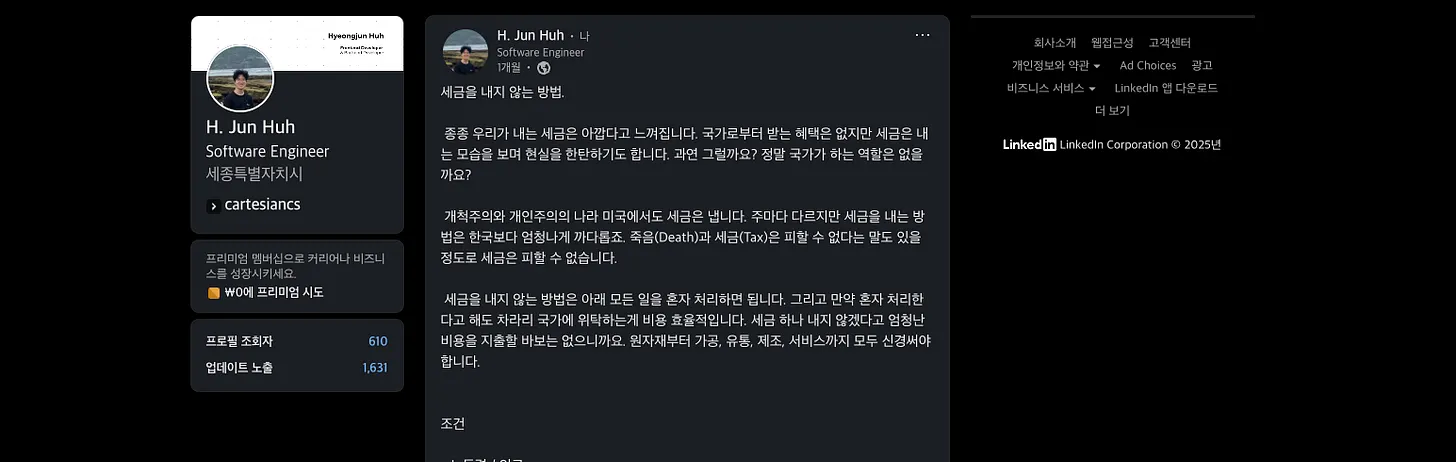
The post is titled “How Not to Pay Taxes,” but the conclusion is that taxes must be paid. The money an individual earns is built on the basic infrastructure provided by the state, so it cannot be entirely attributed to one’s own efforts.
Ironically, many wealthy individuals fail to recognize this point. They complain, “Why does the state take away the money I earned through my efforts?” They lament about taxes, unaware of their blessed life and consumed by the desires in front of them.
Sovereignty
A state is an entity with sovereignty. In essence, every state is ‘true’ in itself. A state can define what is right and wrong, and these definitions are codified in the constitution and institutionalized through laws. The legislative branch discusses and defines righteousness, the judiciary enforces and maintains order based on the laws, and the executive branch assists in the smooth operation of the legislative and judiciary while caring for the well-being of the citizens.
The separation of powers learned in school in Korea was a system established under Article 1, Section 2 of the Constitution, which states that ‘sovereignty resides in the people,’ but it does not grant true sovereignty in itself.
True sovereignty, as mentioned here, can be called the right to define righteousness for oneself, interpreted as the most fundamental right with self-independence and absolute power. Since this right cannot be granted to every natural person, sovereignty is considered to reside in the collective of the people.
If everyone claimed their independence and righteousness, it would lead to the destruction of order. Moreover, like the failure of anarchism, it would result in a state that is ideally perfect but immediately broken. Without a state, an individual has no power or meaning.
Pioneering Spirit
The pioneering spirit partially includes the concept of sovereignty. It is the spirit of enjoying complete freedom while also taking on the associated risks. The state cannot protect an individual’s property rights, and personal disputes must be resolved by the individual, embodying an extremist spirit.
Think of the era of westward expansion. People searching for gold, the era of cowboys and guns. A time when force resolved everything. In such a situation, an individual can enjoy complete freedom, but freedom in a situation where one can die immediately is a trite freedom experienced since the dawn of humanity.
Therefore, the pioneering spirit can also be interpreted as a longing for the state of nature. The desire not to be captured by anyone. The spirit of pioneering life and enjoying complete freedom exists in everyone.
However, if a pioneering lifestyle continues, humanity cannot achieve progress. All personal relationships must unfold on an institutional basis to trade safely, advance science and technology, create cities, and expand external influence. In other words, not everyone should aim for a pioneering lifestyle.
The pioneering spirit should be limited to a temporary value system. It should be a special state that occurred in an era of expansionism, and the overall benefit decreases when everyone possesses a pioneering spirit.
Institutionalization and Taxes
So humanity establishes states and collects taxes. To execute the contents written below. (I brought the list directly from LinkedIn.)
Conditions
-
Labor force / Population
-
Territory / Space / Civil Engineering / Architecture
Core Facilities
-
Military / Intelligence Facilities
-
Energy / Power / Oil / Transmission Lines / Transformers / Power Generation Facilities
-
Water Supply / Purification Facilities / River Facilities / Dams
-
Communication / Telecom Companies / Broadcasting / Data Centers
-
Transportation / Highways / Railways / Flight Routes
-
Finance / Financial Facilities / Bank of Korea / Minting Corporation
-
Food / Large-scale Food Storage Bases / Seed Vaults
-
Medical / Hospitals / Disease Control Agency
-
Industry / Manufacturing / Production Facilities / National Industrial Complexes / Steel / Semiconductors
-
Government and Administration
Systems, Sustainability
-
Law / Judiciary
-
Security / Firefighting / Corrections
-
Economy / Market / Trade
-
Education / Culture
-
Research / Development
-
Diplomacy / International
-
Environment
If you think about trying to do all of this as one person, it’s actually absurd. Ultimately, you get stuck with labor force and territory.
However, in the Future
In fact, the content written on LinkedIn is not a message to pay taxes. Rather, it implies that if an individual can do all the above, they can pay as little as 15% in taxes. Minimal security (military power), solar energy, water purification, local communication, drone transportation, food cultivation, 3D printing. And in the upcoming era of physical AI, an individual will own more than two slave robots. Thus, the labor force issue also becomes a non-issue.
Literally, a wealthy individual could establish a state akin to a medieval nation, and under the name of a corporation, they could be guaranteed a certain degree of autonomy and independence. Somewhere between extreme pioneering liberalism and conservative institutionalism, an individual might achieve independence by relinquishing maximum rights and duties from the state in exchange for minimal property rights.
Ultimately, if initial investment is possible and a sustainable cycle can be maintained, the state can reduce taxes, solve environmental issues, and become a haven for those who long for freedom. However, the moment you actually calculate it, taxes will seem cheap. Only 1. those who truly desire freedom or 2. foolish people will establish a corporate form of state with sovereignty, and in the future, it is likely to end up like the East India Company.
Therefore, if you really don’t want to pay taxes, consider thinking of the state as a subscription-based SaaS for long-term subscription.