Palindrome
When I talk with my friends, we often end up saying, “Whoa, when did we get this old? We’re already 22!” In absolute terms we’re young, but relatively speaking, it’s an age you start to feel. Of course, we’re still in our early twenties, and I feel it’s fine to live a little more boldly. Cynicism is the mindset I guard against most, and I don’t want it to become a habit this early, in my twenties.
The world is full of unwritten rules that everyone takes for granted. As a kid, I picked them out and broke them, one by one. I disrupted systems that were running just fine, and I hunted down and exploited the vulnerabilities that open up when people can’t be bothered. Hacking to some, violence to others, a disciplinary matter to others still. What rescued my innocent, carefree self was none other than the kindness within the system. Once I got to high school, I made a vague promise to pay back the kindness I’d received.
From high school on, I focused on nothing but software. I built quite a few products, working out what makes a product good and what kind of product people get excited about, and I savored the joy of creating. Sometimes I’d build a VR game with WebXR; other times I’d implement an FFT from scratch in WASM. The 41 public repositories in the GitHub organization I created back then are the proof.
Yes. I’ll give myself some credit for having lived pretty diligently. But looking back, it meant nothing, and I regret that I built things back then without ever sharing them publicly. I’ve come to realize that praising the past is just flattery that teaches you nothing.
I still remember, as vividly as if it were yesterday, resolving not to be distracted by the things we’re “supposed” to do. As Fields Medal–winning mathematician June Huh urged in his commencement speech1, I shouldn’t worry too much about keeping the unwritten rules of what we’re supposed to do in life.
I went back and reread “5 Reasons Why I Don’t Reveal I’m a High School Developer”2, which I wrote in 2023.
If I am satisfied with my status as a high school student now, there will be many days of relative dissatisfaction in the future. I can’t always rely on the glory of the past.
Now it reads a little differently. It feels like a warning to my future self.
In the past, we’re unhappy because we fear the future; in the future, because we rest on the past. For a moment, let’s imagine it’s all an illusion and let it go. The things we’re “supposed” to do depend on what we choose. I wonder whether any life could be unhappier than one that outsources the major choices that shape it.
No. I confess that I didn’t give it my all; I wasn’t desperate in every moment. The compounding effect comes from good choices piling up, moment after moment. I didn’t manage that.
At the end of “The Definition of Success”, a post I wrote recently, I said: “Compounding and trust, built up slowly, become the foundation for explosive growth later on.” The fine details of a good product. Good results that pile up day after day create compounding, and that compounding creates more compounding in other areas. It all happens as a chain reaction, widening the range of choices you have.
And with the choices this opens up, I have to pass kindness on to future generations. If I’m lucky enough to succeed in a big way, I’ll start a fund and invest in founders while asking little in return; and even if that never happens, a peaceful old age spent sharing a beer with friends and family will be enough. Reality is too beautiful to focus only on idealized unwritten rules.
Nietzsche urged us not to run from life’s pain and emptiness but to embrace them, living this very moment as fully as possible. The questions of the past answer the present, and the past answers the questions of the present: this compounding across the axis of time is what makes our lives beautiful, and it’s the reason we live. That is how we finally come to focus on the present.
-
While writing this, I kept thinking about how I could write it better. I’m not sure it came across well to you. Satisfying a form is hard, and getting the flow right is even harder.
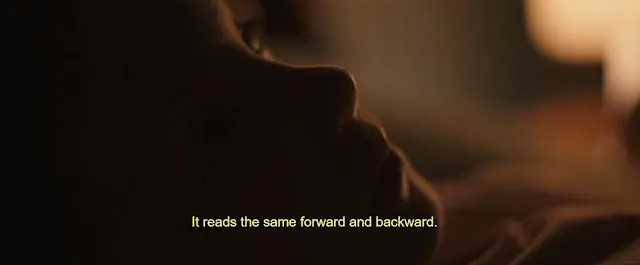
The piece is built as a palindrome — a word that reads the same forward and backward. With the quote in the middle as the pivot, the first six paragraphs pose immature questions, and the paragraphs that follow are their corresponding answers.
The question is: what is language? Given enough time, you might be able to convey context rivaling a neural network, but in the end, complete understanding of another person is impossible. Even if it were possible, it would be inefficient. Plot your understanding of another person against time, and you get a saturation curve with a ceiling.
James Cameron’s Avatar answers that Eywa connects the neural networks of every living being, bringing about a kind of hyper-empathy. It suggests a religious experience in which the other becomes me and I become the other. We humans package language and knowledge in grammar to pass them along. In the process, context gets lost, and misunderstanding and distrust inevitably follow.
I believe AI agents can bridge the gap that language leaves. If there were an agent that took in my unique experiences, perceptions, and perspective exactly as they are, the other person’s agent could relay them, standing in for empathy. And I think this era of AI agents will eventually be absorbed by the arrival of BCI (brain–computer interfaces), making humanoid–human and even human–human connections possible. I imagine it would be an incredibly subtle experience: the speaker’s perspective simply “surfacing” in your mind, just as it is.
Which unwritten rules I broke, I’ll leave to your imagination. I think everyone has gone off the rails at some point in life, to a greater or lesser degree. Try reading it with your own experiences filled in. Likewise, I won’t spell out what the kindness within the system was.
In the same way, the unwritten rules of what we’re “supposed” to do refer to what June Huh described in his speech: “I hope you won’t be distracted by preparing for a job, preparing for marriage, child-rearing, education, promotion, retirement, and old age, all of it in preparation for dying in some respectable private room in a hospital somewhere.” If this is your first read, you’ll probably feel like the whole piece takes quantum leaps. The context is deliberately left out; it was written to be read more than once. The conclusion you reach by actively interpreting the structure is the real conclusion of this piece.
I went back and forth on whether to include the second paragraph. I didn’t want to come across as crazy. In an interview, director Shin Woo-seok of Dolphiners Films said there are “two kinds of people who come in for interviews”: ‘normal people who want to look crazy, and crazy people who want to look normal.’ I want to look normal.
Still, the piece isn’t complete without that paragraph. After all, everyone lives by an unwritten rule of wanting to look ‘normal.’ The heart of this piece is to know those unwritten rules but not to live by them, and if the author were the one fussing over them, it would take the fun out of reading it. I didn’t want to create a contradiction between what I write and what I do.
Translated by Claude Opus 5.5